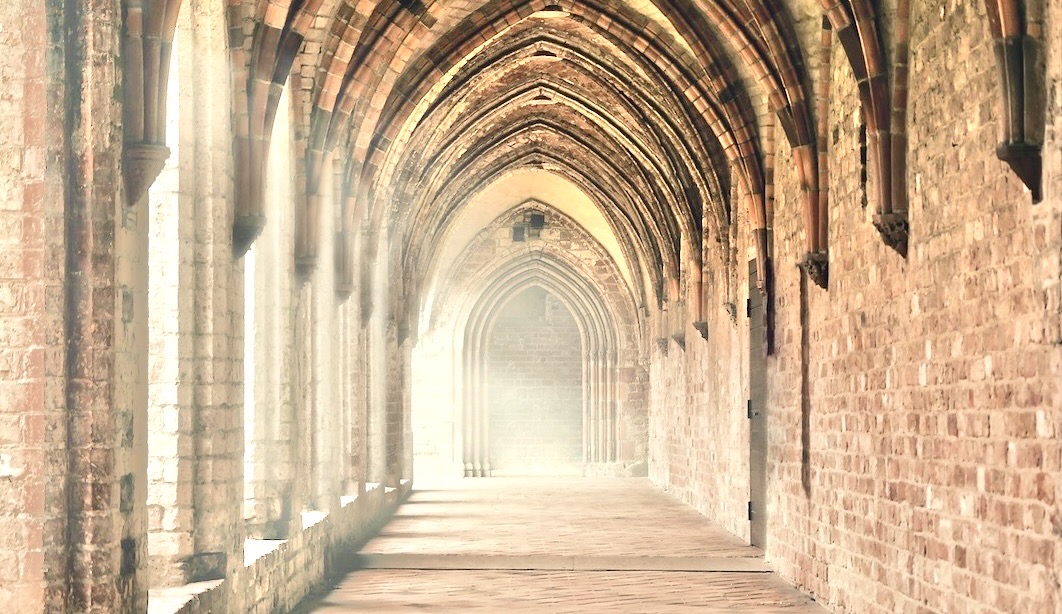


Who were these monks (and nuns) whom Henry VIII dispossessed? Well, it depends on who you ask. The King’s commissioners, overseen by his advisor Thomas Cromwell, painted an unflattering picture, depicting many of the monks as overfed, impious, venal, and sexually lax (particularly prone to the sin of “voluntary pollution”—i.e., masturbation). Over the centuries, some historians took these accounts at face value and characterized English monastic life as so lax and corrupt that its demise was inevitable.
But recent research has yielded a more nuanced view, citing evidence that into the 1530s some monasteries were inducting large numbers of novices, renovating their physical structures, and actively serving the poor and sick in their communities. It appears, then, that while certain monasteries may have been underinhabited and undisciplined, others were thriving and devout.

So in writing Beyond Where Words Can Go, I’ve assumed that any individual monastery would have its own distinct character, and I’ve chosen to depict one that is relatively small, modest, and devoted to its mission. I’ve also assumed that individual monks were as varied as any group of humans, with disparate levels of education, religious devotion, and adherence to monastic discipline. Of more intimate details—for instance, whom did they love, and how?—there is of course little to no historical record, as putting such feelings and actions into writing could be fatal. So I’ve had to rely on imagination—but have tried to keep it from rambling too far beyond what we know about this world and those who dwelt within it.
Copyright 2026 Richard Smith